02 / STUDENT INITIATIVE · CO-FOUNDER
Quant Society
Investment competitions, a virtual trading platform, and quantitative finance tools developed with a co-founder.
Visit Quant Society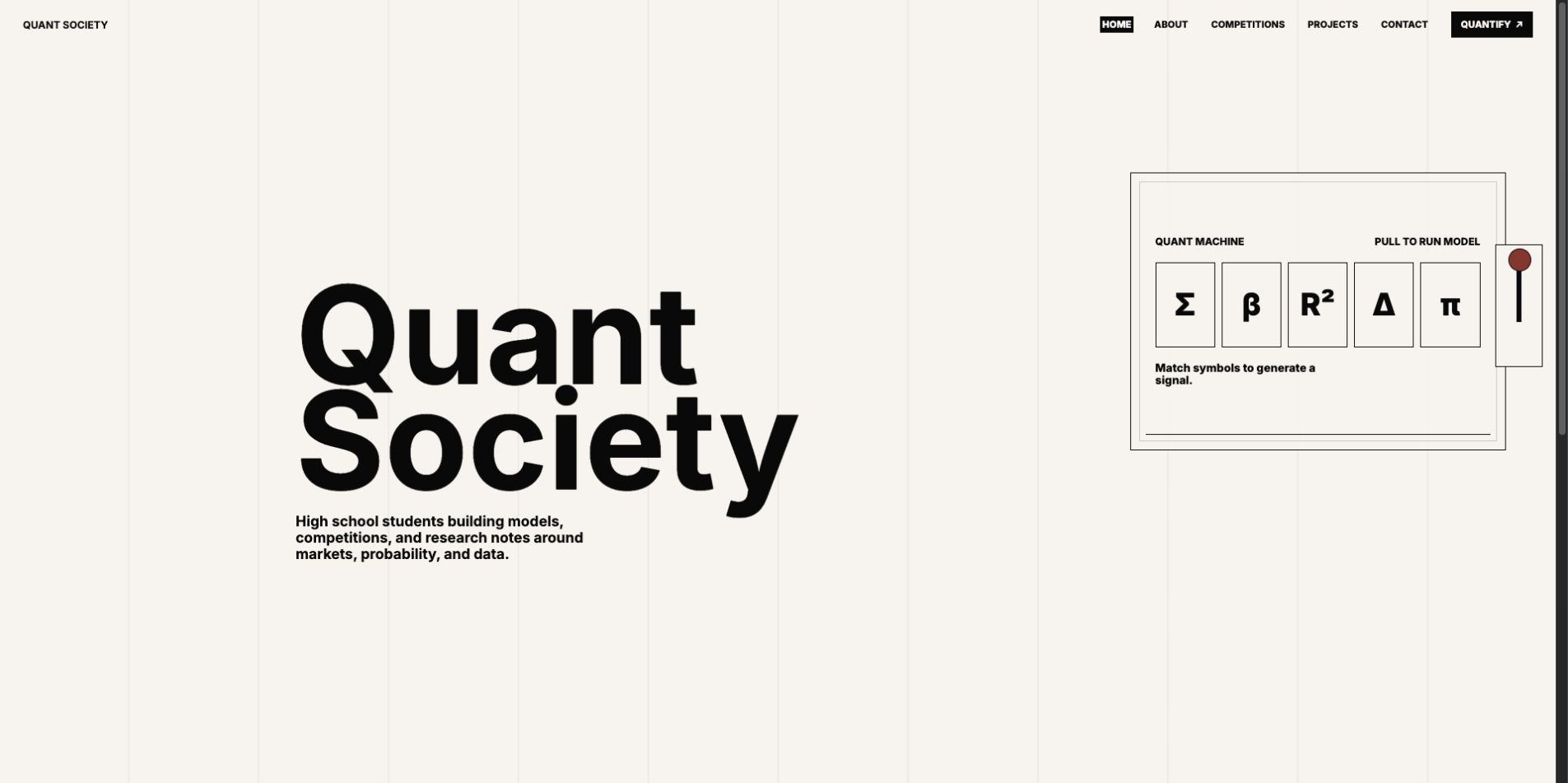
ABOUT THE PROJECT
Overview
Quant Society is a project I co-founded with a friend to give students practical ways to explore finance. We organize investment competitions, develop quantitative tools, and publish reports explaining the work behind them. Quantify is the virtual trading platform we built to support our competitions.
The project brings together two kinds of work: creating opportunities for students to make and defend investment decisions, and building tools that let us investigate financial ideas ourselves. The website brings the competitions, applications, and reports together.
How the competitions worked
Teams managed virtual portfolios around a client's needs, rather than choosing investments only for their own preferences. They had to consider funding requirements, risk, diversification, and the reasoning behind their choices.
Our competition case study uses a hypothetical foundation that must fund annual youth-sports grants while working toward a longer-term community centre. Its six-week format includes an initial strategy stage, a trading period, and a final written report. The brief gives teams competing priorities to balance, and judging considers whether their strategy suits those goals as well as how the portfolio performs.
Quant Society / Software
Quantify
A SaaS platform for running investment competitions.
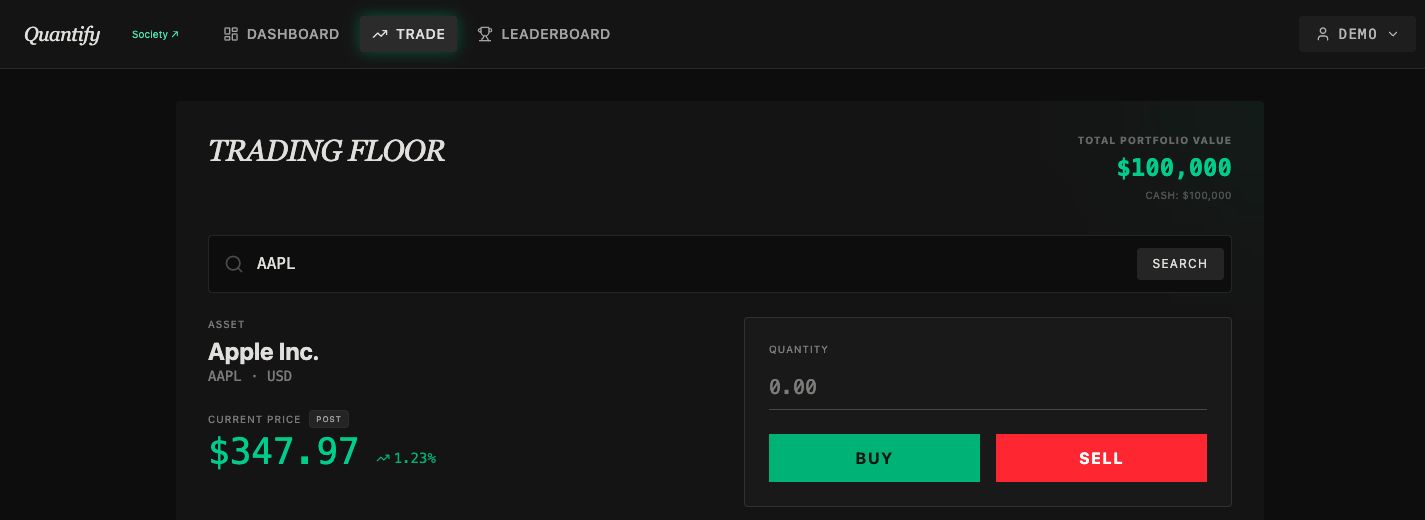
We built Quantify as a software-as-a-service (SaaS) platform for competition organizers. It brings team administration, virtual trading, stock research, and portfolio tracking into one browser-based tool. We originally developed it to run our own competitions, with the longer-term aim of making it usable by other organizing teams.
The SaaS idea is to make the underlying software reusable across competitions. Organizers can set up their teams and constraints, while participants use the same platform to put their strategies into practice. The competition brief can change while the tools for administering teams and managing virtual portfolios remain in place.
01 / OrganizeSet up the competition
Add and edit teams and set competition constraints. The organizer controls the setup, giving each team a shared set of rules to work within.
02 / TradeManage virtual portfolios
Research stocks, place virtual trades, and track holdings. Teams can connect the reasoning in their client strategy with the positions they take.
03 / FollowWork with market data
Follow delayed market prices from Yahoo Finance and charts from TradingView while reviewing the portfolio's changing value and exposure.
My contribution
I worked with my co-founder on the competitions, Quantify, and the quantitative projects published through Quant Society. My involvement connected the work of building the tools with deciding how students would use them in a competition.
This was a collaborative project. The competition format, platform, and reports reflect our shared work, and the four project descriptions below link to the applications and technical reports themselves.
Running and improving the competitions
Some participants told us that they had initially chosen stocks because the companies were familiar or popular. The competition encouraged them to look more closely at company performance, industry news, and how an investment fitted the client's needs. Other feedback focused on diversification and the effect that one large position could have on the whole portfolio.
These comments gave us useful feedback about the format. They are informal observations, not a measured assessment of learning. Running the competitions also gave us experience using Quantify with participants and identifying parts of the platform that still need work.
Further development
Quantify remains a working prototype. We have used it ourselves, but bugs and testing needs remain before another organizing team could comfortably use it without our help.
The next stage is to improve reliability, test the organizer and participant workflows more thoroughly, and make setup instructions clearer. Longer term, I would like organizers to be able to adapt the platform to their own competition rules and client briefs. We also want to keep developing projects whose reports make the methods, results, and limitations easy to examine.
Project
We developed four Python projects with interactive applications and accompanying reports. Each explores a different part of financial decision-making, from evaluating a prediction to deciding how much to risk.
Stock Direction Predictor
This project uses historical price and market data to predict whether a stock will move up or down the following day. It compares logistic regression and random forest models with a simple baseline. The accompanying report explains the testing process and why the results do not establish a reliable trading advantage.
Monte Carlo Simulator
This tool uses many possible price paths to estimate option values. Users can change inputs such as volatility and time to expiry, then examine how those assumptions affect the results. The report explains the pricing methods and checks the estimates against established approaches.
Trading Backtester
This tool tests trading rules against historical market data. Users can examine trades, returns, and losses while accounting for transaction costs and the timing of each trade. The report explains how the calculations work and the limitations of using historical results to judge a strategy.
Kelly Betting Simulator
This project explores how much to risk when the probability of success is uncertain. It compares different approaches to position sizing and shows how they affect growth and losses over repeated trials. Users can adjust the assumptions and see how a more cautious estimate changes the amount committed.