03 / VIRTUAL PORTFOLIO · CO-FOUNDER
ALMA Fund
A virtual investment portfolio documenting how we learned to research investments, manage risk, and review our decisions over a year.
Visit ALMA Fund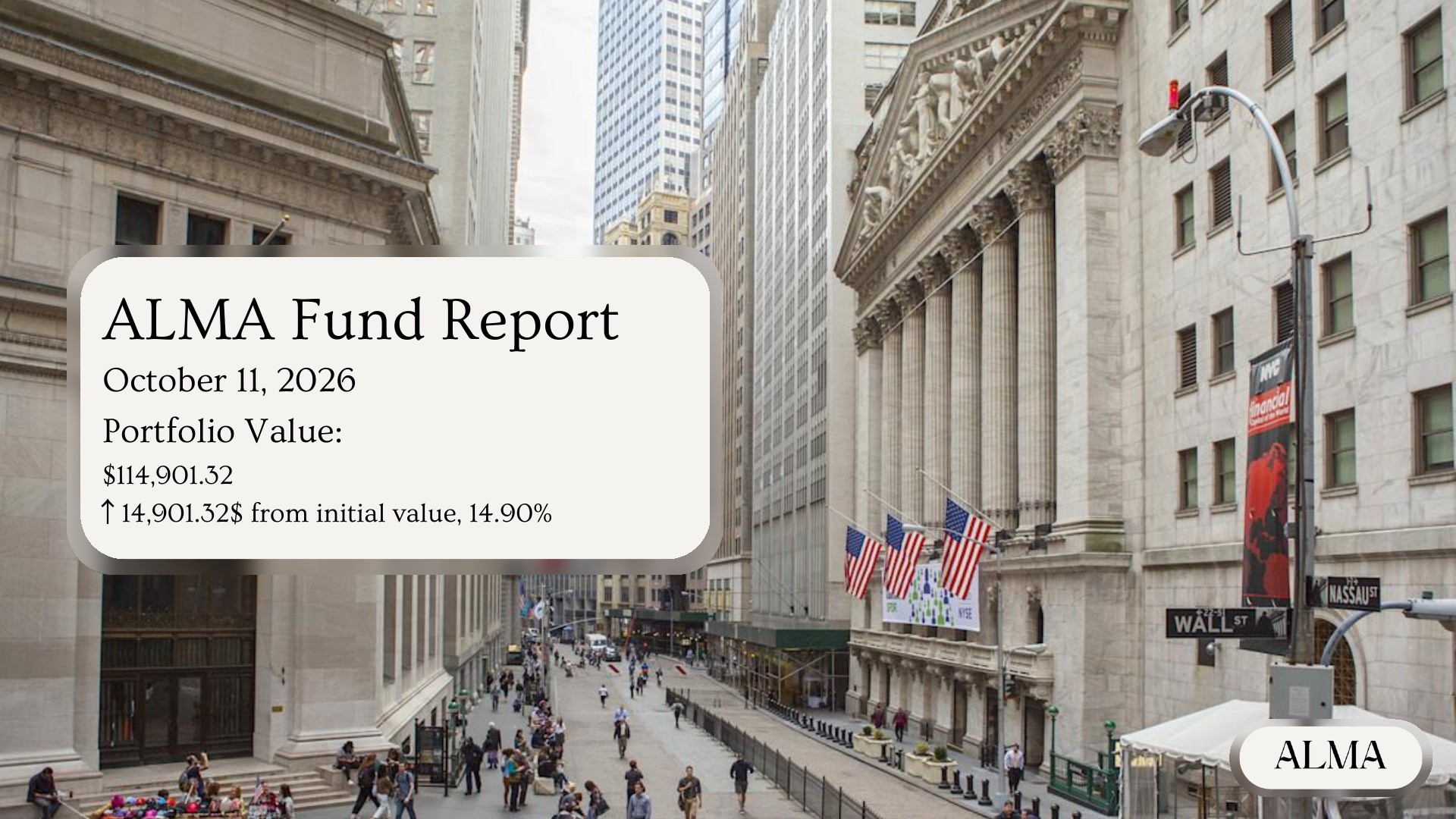
ABOUT THE PROJECT
The project and my role
ALMA Fund is a project I started with friends to learn about investing by managing a virtual portfolio. We began with a $100,000 eToro practice account and invested across stocks, ETFs, and commodities. The aim was to follow our decisions over a sustained period and document how our approach developed.
As a co-founder, I worked on investment research, portfolio decisions, and the reports we produced together. The project involved discussing possible investments, following market developments, and reviewing the choices we had made. We used regular reporting to keep a record that we could return to at the end of the year.
How our approach changed
At the beginning, our research relied mainly on company ratios, news, and analyst expectations. We were eager to identify opportunities and build positions. Over the year, we began looking more carefully at the business, valuation, possible catalysts, and the risks that could undermine an investment.
Our understanding of diversification also changed. Holding several companies did not necessarily mean the portfolio was well diversified if they depended on the same sector or market conditions. We started paying more attention to concentration, asset types, and the amount of exposure carried by each position.
Monitoring became another important part of the process. The reports describe a position moving from a large unrealized gain into a loss after new information emerged. That experience showed us why entering a trade needed to be followed by regular checks and a willingness to reconsider the original reasoning.
Strong periods and setbacks
October 2025 — early gains. Positions including TSM, Newmont, and gold-related exposure contributed to a strong opening period. The gains built our confidence, but later results showed that identifying opportunities was only one part of managing the portfolio.
November 2025 — a profitable mistake. Experimenting with leveraged orders created unintended exposure. Although the position ended profitably, we treated it in the annual review as an execution failure. Making money on a trade did not mean that we had controlled its risk properly.
December 2025–January 2026 — losses and restructuring. A period of losses made us reconsider position selection, allocation, and how closely we monitored the account. We then reconstructed the portfolio and reassessed its diversification and exposure.
May 2026 — the portfolio's high point. On 3 May, the portfolio reached its highest published value of $124,254.87. This was the account value, not a monthly return. The decline that followed made protecting gains and managing risk more important parts of our review.
August 2026 — fewer trades and more flexibility. We reduced the number of new positions and held approximately $20,000 in cash as uncertainty increased. Earlier reporting cycles had often included three to six new securities. Becoming more selective was a practical change in how we worked, alongside more attention to leverage and volatile positions.
Selected investment decisions
Our annual report examines Marvell Technology as a decision that worked. We invested partly because of its position in the AI industry and expected a recovery following weakness in technology stocks. The review considers the original reasoning, the position we took, and our decision to exit. It also examines how we could have handled the investment differently.
The cocoa futures case examines a loss. We entered a leveraged position based on weather-related supply concerns, but had not researched the market and its risks sufficiently. The position reached its stop-loss the following day. Reviewing the trade made the consequences of unfamiliar instruments, excessive exposure, and rushed decisions concrete.
Performance and risk
Our first-year annual report, covering September 2025 to September 2026, records a portfolio value of $118,232.03 from the $100,000 starting balance, a gain of 18.23%. Its comparison with the S&P 500 Total Return Index reports a benchmark gain of approximately 19.47%, leaving the portfolio about 1.24 percentage points behind.
The ending balance does not describe the whole year. The report also records a maximum drawdown of 11.18%, showing the largest decline from a previous portfolio peak. Looking at the gains alongside the losses helps us assess how much risk we took and whether our decisions were consistent.
Reports and annual review
The biweekly reports document portfolio changes, market developments, and our investment reasoning at different points in the year. They provide a record of what we were thinking while decisions were being made.
The annual review brings that record together. It examines performance against the benchmark, individual investment cases, and changes to our process. Reading both types of report makes it possible to follow an idea from its original reasoning to the outcome and subsequent review.
Plans for the next year
For the next year, I want us to apply a more consistent process before and after each investment. Our annual report sets out plans for written investment theses covering the reason for entering, the expected catalyst, the main risks, and the conditions that would make us reconsider.
We also plan to review positions on a defined schedule, check the exposure involved before placing an order, and write short reviews when positions are closed. Continuing the biweekly reports will let us examine whether those changes become regular practice. The aim is to improve the quality and consistency of our decisions as we continue learning.